
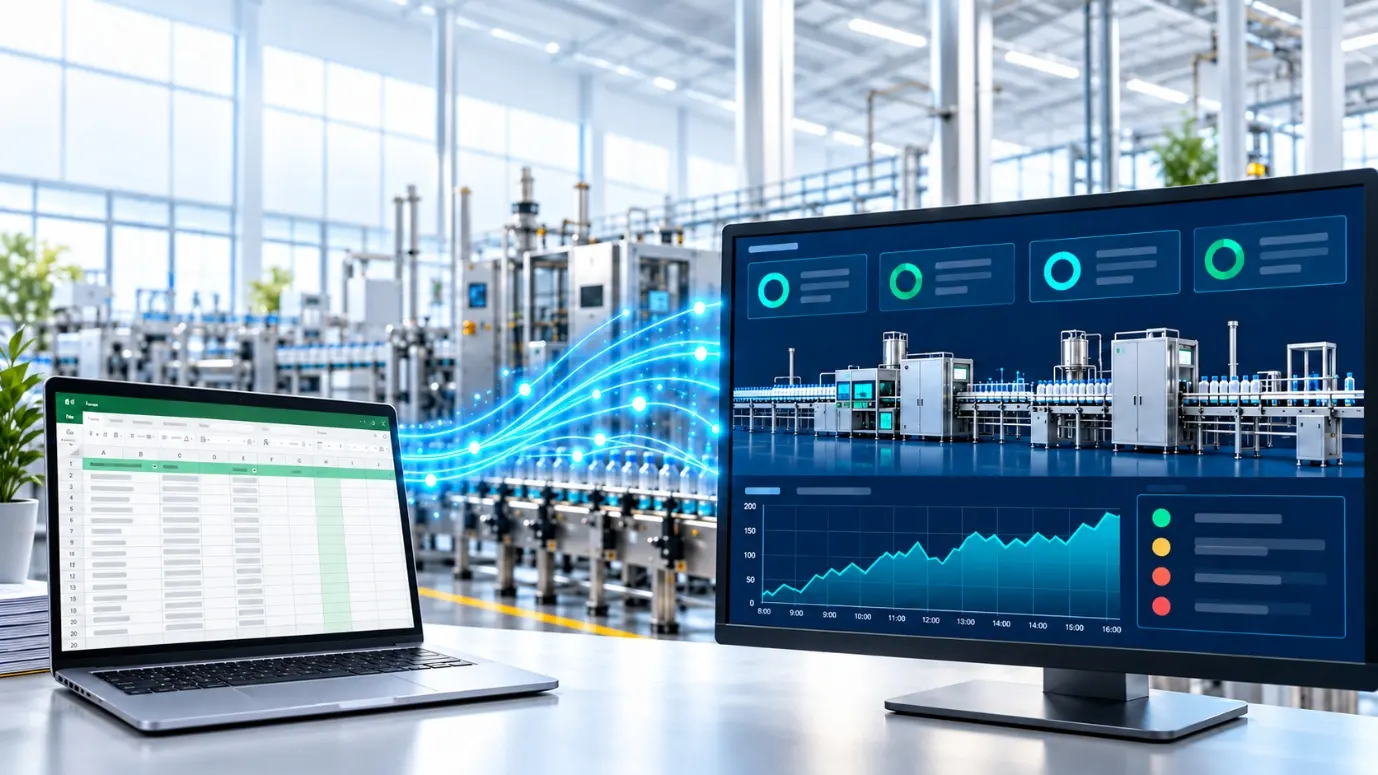
7 Signs Your Factory Has Outgrown Excel and Needs a SCADA System
For many growing manufacturers, MS Excel starts as a simple reporting tool.
But as automation increases and production lines expand, spreadsheets often become a limitation rather than a solution.
If your factory relies heavily on Excel for production tracking, downtime logging, or KPI reporting, it may be time to consider a dedicated factory monitoring system — specifically, a modern SCADA system.
Here are 7 clear signs your factory has outgrown Excel.
1. Data Is Collected Manually from PLCs
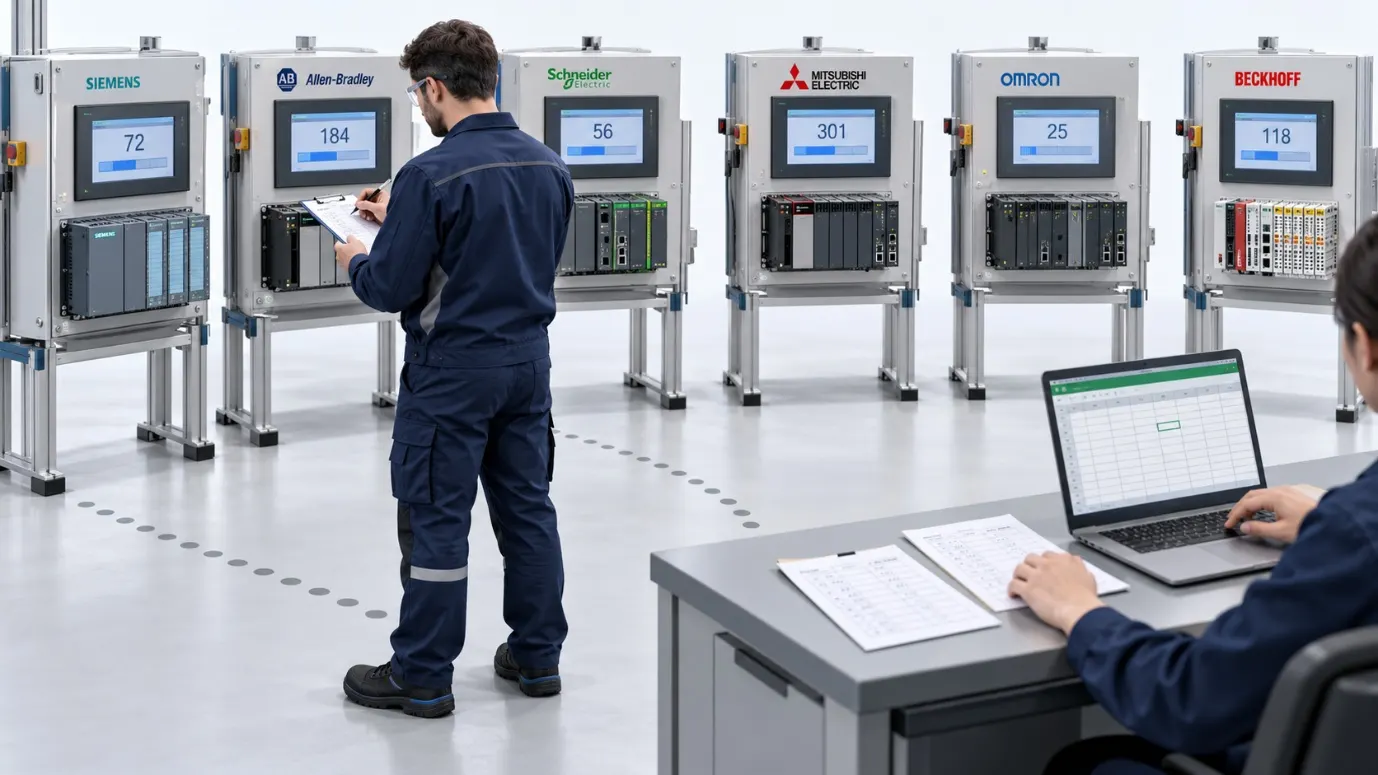
Operators often:
- Walk to machines
- Read data from HMIs
- Export CSV files
- Copy values into Excel
This approach:
- Is slow
- Introduces human error
- Prevents real-time analysis
PLCs such as Siemens SIMATIC S7 or Allen-Bradley ControlLogix generate valuable real-time production data. Without an automated factory monitoring system, that data remains underutilized.
A SCADA-based factory monitoring system connects directly to PLCs and collects data continuously — without manual intervention.
2. There Is No Real-Time Factory Monitoring
Excel is static. Even if updated every hour, the data is already outdated.
A modern factory monitoring system provides:
- Live dashboards
- Real-time production tracking
- Instant status visibility
- Immediate alarm notifications
Without real-time factory monitoring, issues are discovered too late — increasing downtime and production losses.
3. Alarm Management Depends on Human Observation

In Excel-based environments:
- Operators notice issues manually
- Alarms are written into logs
- Problems are reported by phone or email
This is not a structured factory monitoring system.
A SCADA-based factory monitoring system automatically:
- Evaluates alarm conditions
- Logs every event with timestamps
- Sends notifications
- Stores complete alarm history
Reliable alarm management is one of the biggest differences between spreadsheets and industrial monitoring software.
4. Each Production Line Has Its Own Spreadsheet
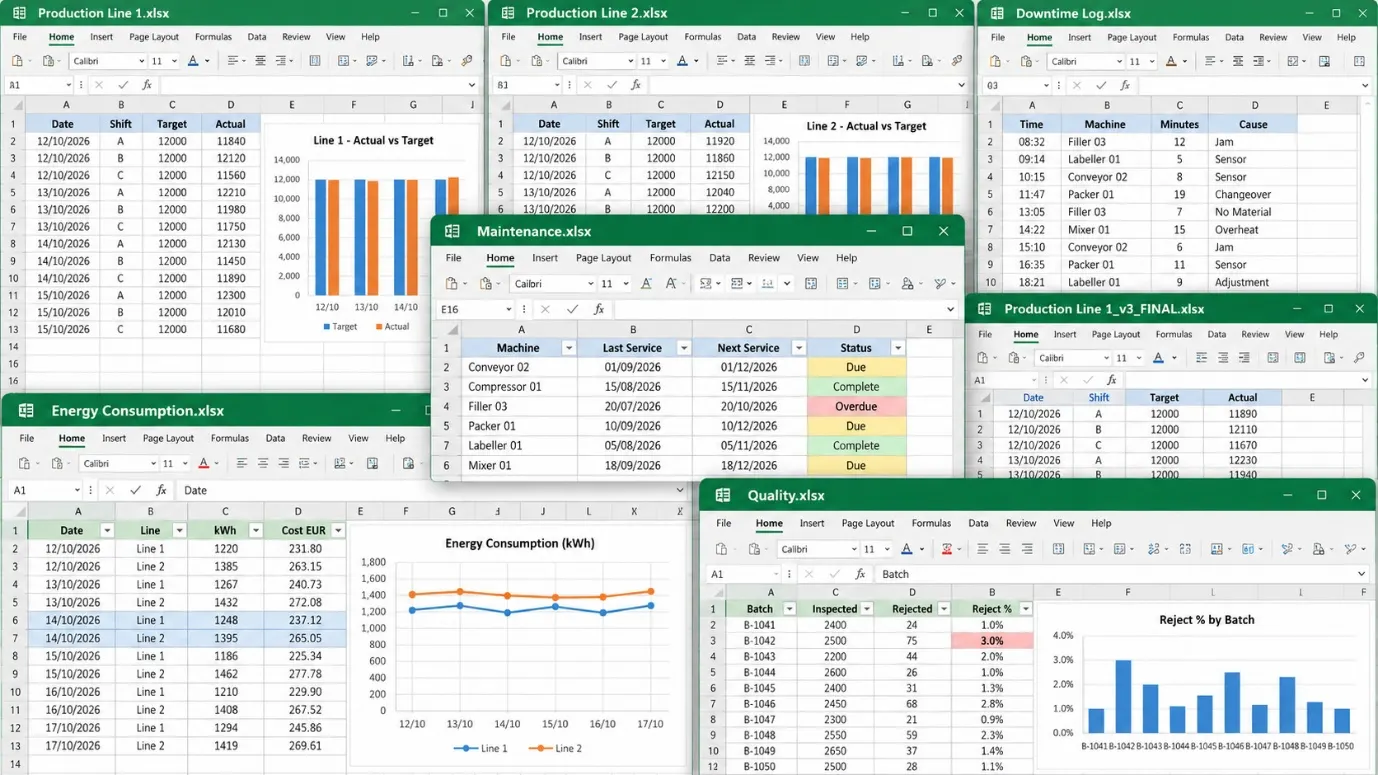
As factories scale, Excel files multiply:
- One per production line
- One for energy
- One for maintenance
- One for quality…
Soon:
- Data conflicts appear
- Versions are inconsistent
- Reports differ across departments
A centralized factory monitoring system consolidates all PLC data into one structured platform — eliminating data silos.
5. Management Requests KPIs You Cannot Provide Quickly
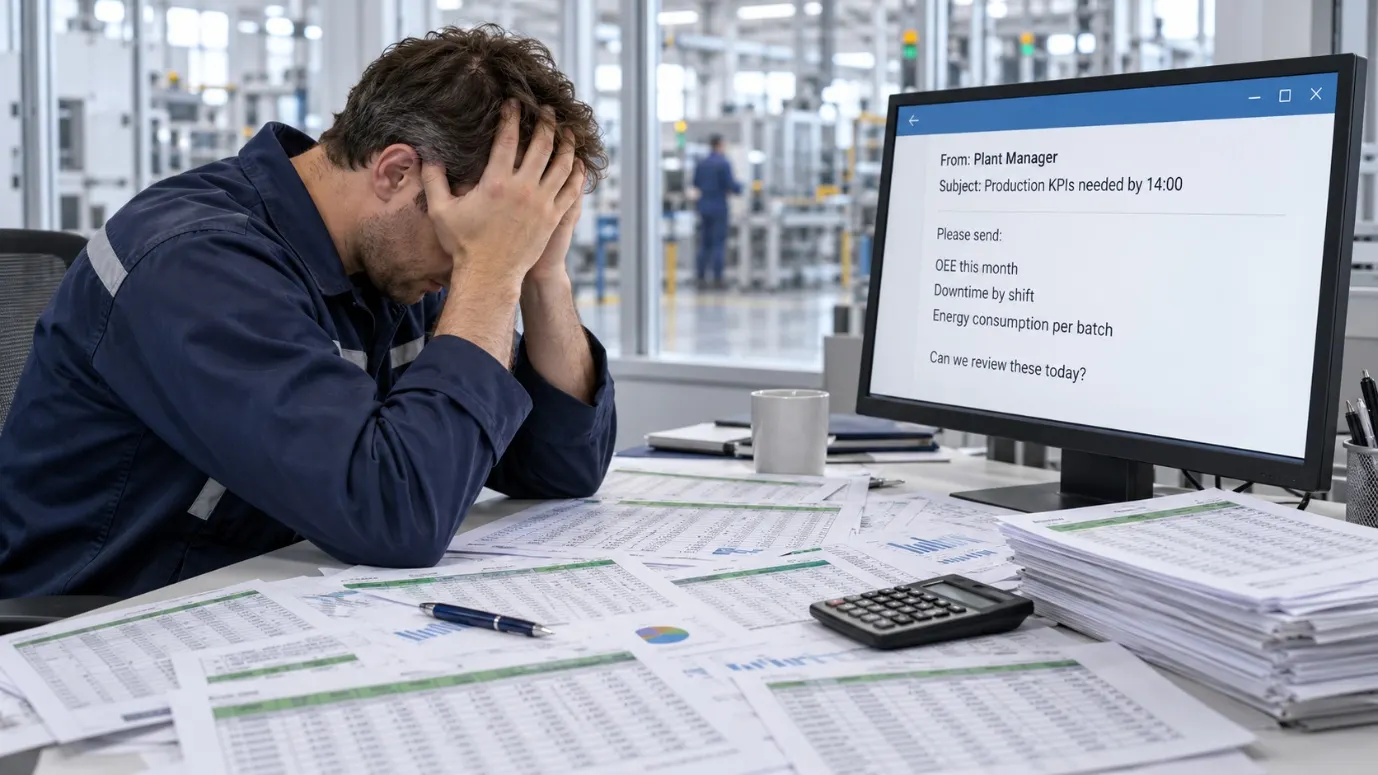
Common management questions include:
- What is our OEE this month?
- Which shift has the highest downtime?
- What is the energy consumption per batch?
- Where are recurring bottlenecks?
If answering these questions requires merging spreadsheets manually, your reporting system is not scalable.
A SCADA-based factory monitoring system:
- Stores structured historical data
- Provides automated reports
- Enables real-time KPI dashboards
- Supports production optimization
6. Remote Monitoring Is Limited or Insecure
Modern factories often operate:
- Multiple sites
- Distributed production lines
- Remote maintenance teams
Excel typically:
- Resides on a local computer
- Is shared by email
- Causes version conflicts
A modern factory monitoring system allows secure web-based access with user roles, audit trails, and encrypted communication.
This is essential for multi-site production environments.
7. Downtime Costs Are Increasing — But Root Causes Are Unclear
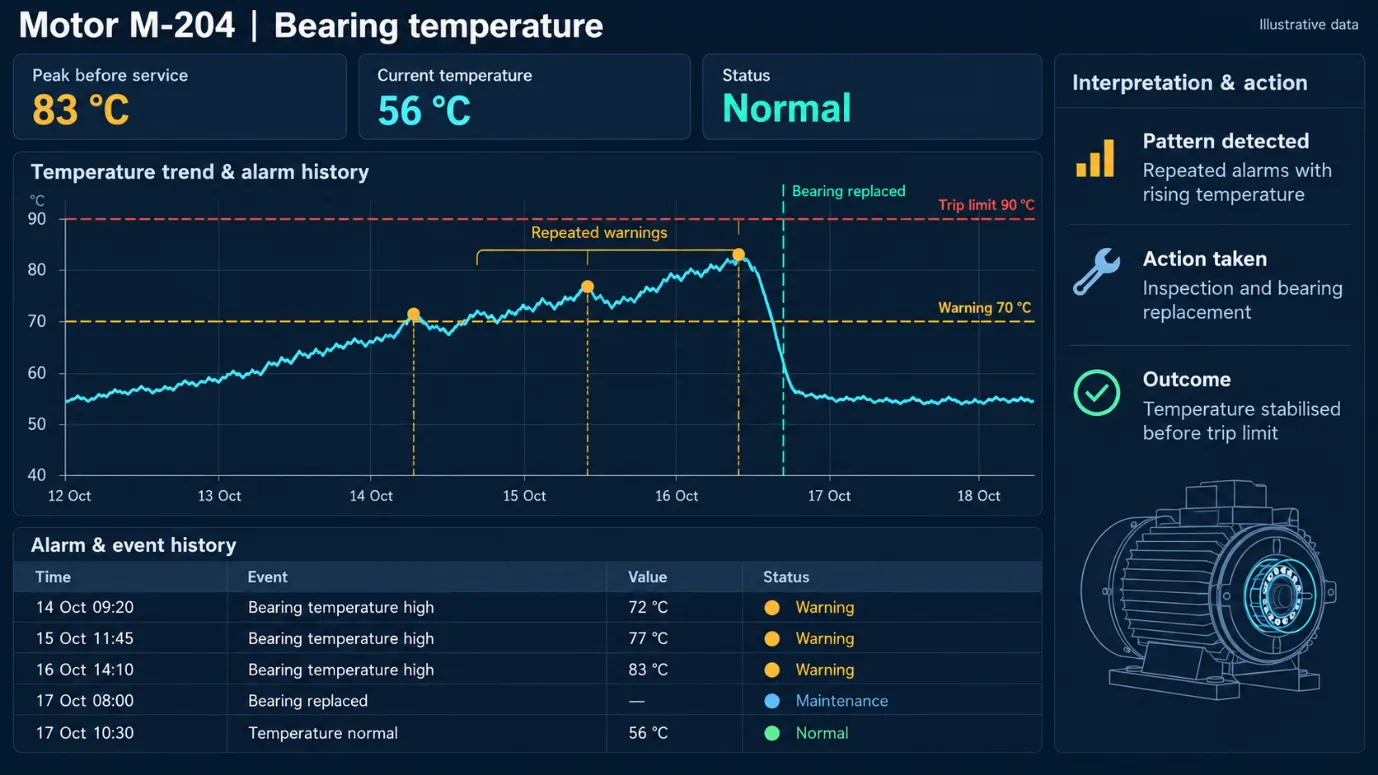
When downtime occurs, you need:
- Precise timestamps
- Alarm history
- Machine state transitions
- Trend analysis before failure
Excel rarely provides structured historical event logging.
A SCADA-driven factory monitoring system records:
- Every alarm
- Every process variable
- Every machine state change
This makes root cause analysis measurable and repeatable.
Excel vs Factory Monitoring System: Clear Comparison
| Capability | Excel | SCADA-Based Factory Monitoring System |
|---|---|---|
| Real-time data | ❌ | ✅ |
| Automatic PLC integration | ❌ | ✅ |
| Centralized plant overview | Limited | ✅ |
| Alarm management | ❌ | ✅ |
| Historical data logging | Manual | ✅ |
| Multi-site monitoring | Difficult | ✅ |
| Secure user roles | Limited | Advanced |
Excel is a spreadsheet tool.
A SCADA system is a dedicated industrial factory monitoring system.
Short Summary
You should consider moving from Excel to a SCADA-based factory monitoring system when your operation grows beyond simple, manual data handling. For example, if you are running multiple PLC-controlled machines, consolidating data across them in spreadsheets becomes inefficient and error-prone. When downtime directly impacts profitability, relying on delayed or manually compiled reports limits your ability to react quickly and minimize losses.
The need for change also becomes clear when manual reporting consumes significant engineering or management time, reducing productivity and increasing the risk of inconsistent data. Limited production visibility — where performance issues, bottlenecks, or quality deviations are discovered too late — further signals that spreadsheet-based tracking is no longer sufficient. Additionally, if management requires real-time dashboards for operational or strategic decisions, Excel cannot provide continuous live data with proper traceability. Finally, if expansion to multiple production lines or sites is planned, a centralized SCADA architecture ensures scalable, structured, and reliable monitoring.
If your factory depends on data for decision-making, it deserves a structured monitoring architecture rather than isolated spreadsheets.
Final Thoughts
Excel is a powerful tool — but it was never designed to be a real-time factory monitoring system.
As automation grows and production complexity increases, structured data acquisition becomes essential.
A SCADA-based factory monitoring system transforms isolated machine data into operational intelligence, enabling faster decisions, reduced downtime, and scalable growth.
In the next article, we’ll explore the difference between SCADA, MES, and IIoT platforms — and how to choose the right architecture for your factory.
Frequently Asked Questions About Factory Monitoring Systems and SCADA
What is a factory monitoring system? A factory monitoring system is software that collects, visualizes, and analyzes real-time data from machines and production lines. Most modern factory monitoring systems are based on SCADA architecture.
How is a SCADA system different from Excel? Excel stores manually entered or imported data. A SCADA system automatically collects real-time data from PLCs, provides centralized dashboards, alarm management, and structured historical storage.
When should a factory move from Excel to SCADA? A factory should move to SCADA when manual reporting becomes inefficient, downtime analysis is difficult, multiple production lines operate independently, or real-time visibility is required.
Can a SCADA system replace manual production reporting? Yes. A SCADA-based factory monitoring system automates data acquisition and reporting, reducing human error and saving time.
Is a factory monitoring system expensive? The cost depends on scale, architecture, and deployment model. Modern web-based SCADA platforms offer flexible and scalable licensing models suitable for small and mid-sized factories.
Can a factory monitoring system connect to existing PLCs? Yes. Most SCADA systems support industrial protocols such as Modbus TCP, OPC UA, Siemens S7, and EtherNet/IP, enabling integration with existing PLC infrastructure.
A Practical Note on Modern Factory Monitoring Platforms
Today’s factory monitoring systems are no longer heavy, Windows-only software packages.
Modern SCADA platforms are:
- Web-based
- Cross-platform
- Scalable
- API-ready
- Suitable for cloud or on-premise deployment
Solutions like mySCADA focus specifically on delivering lightweight, modern factory monitoring systems that integrate easily with existing PLC infrastructure while maintaining industrial reliability.
The key is choosing a platform that matches your factory’s growth plans — not just current needs.
Continue Learning
This article is part of the Learn Automation hub — a collection of practical guides on industrial automation and SCADA.
Related articles:
- What Is a SCADA System? Architecture, Components & Modern Use — start with the fundamentals
- When Do You Need a SCADA System? Key Signs and Benefits — the operational signals that call for SCADA
- myPRO — Web HMI/SCADA Software — unlimited tags, unlimited clients, web-native
- Success Stories — real mySCADA projects across 20+ industries