
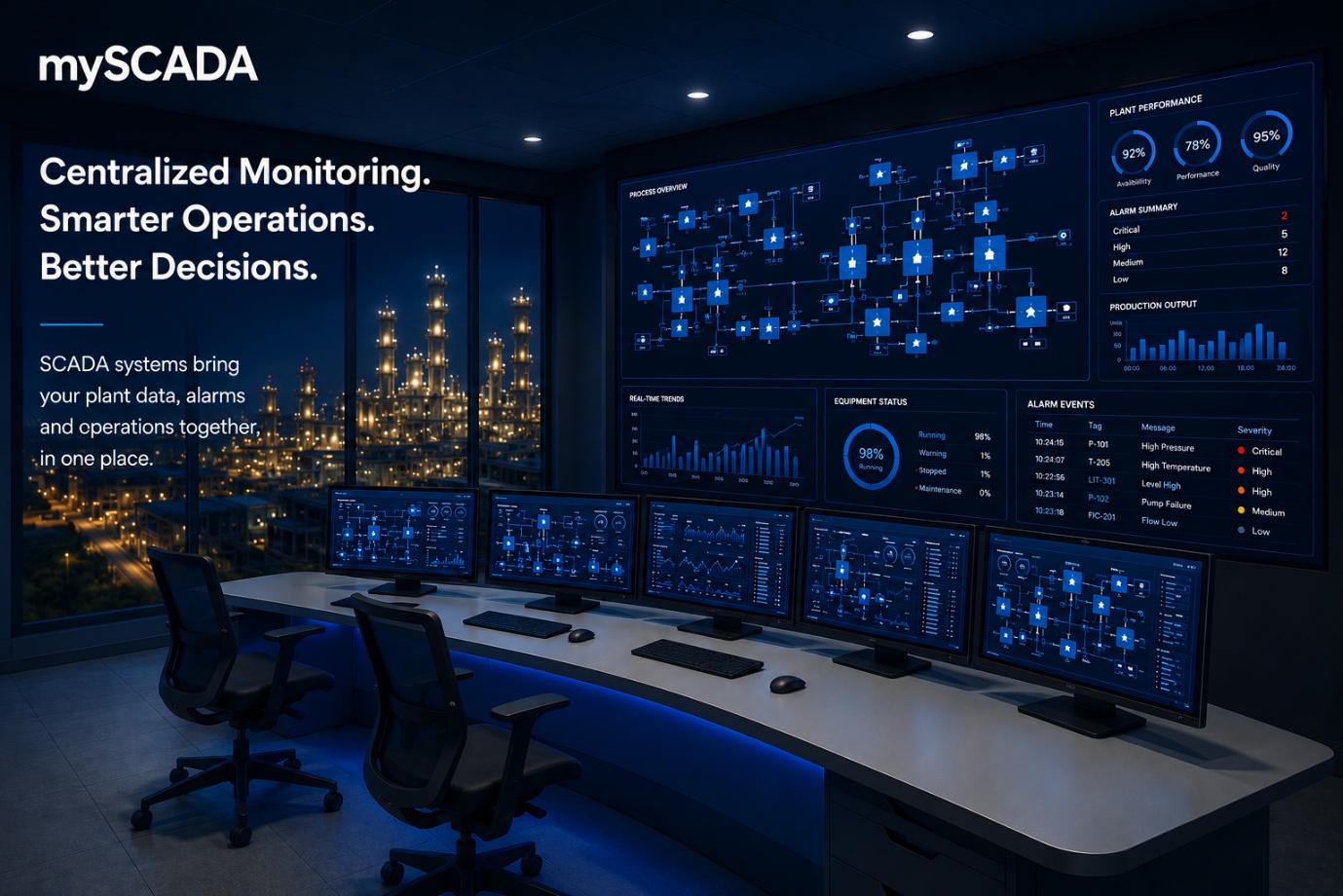
What Is a SCADA System? Architecture, Components & Modern Use
Industrial automation depends on reliable monitoring and control systems. One of the most important technologies in this area is the SCADA system.
- What is a SCADA system exactly?
- How does SCADA architecture work?
- What is the difference between PLC, HMI, and SCADA?
This guide explains everything clearly and practically.
What Is a SCADA System?
A SCADA system (Supervisory Control and Data Acquisition) is industrial software used to monitor, supervise, and collect real-time data from machines, processes, and infrastructure.
A modern SCADA platform enables companies to:
- Monitor multiple PLCs from one central interface
- Collect and store historical production data
- Generate alarms in real time
- Visualize industrial processes
- Enable remote monitoring
- Integrate operational data with business systems
ISA-95 Automation Pyramid: Where SCADA Fits
To understand SCADA architecture, it helps to look at the industrial automation pyramid (ISA-95 model). The pyramid shows how industrial control systems are structured — from physical devices up to enterprise management.
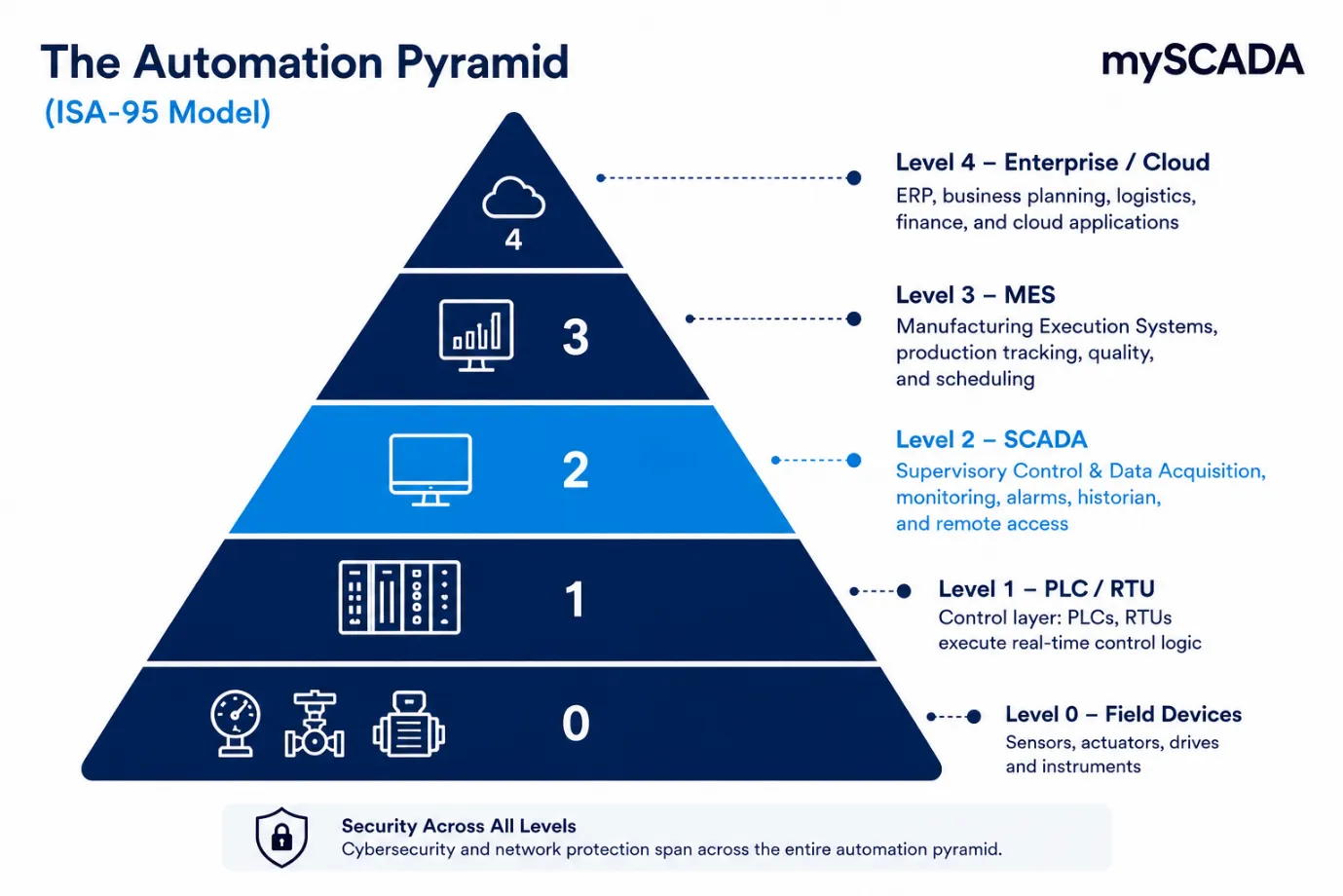
Level 0 — Field Devices Sensors (temperature, pressure, flow), actuators, drives. These devices generate raw process data.
Level 1 — PLC / RTU (Control Layer) Programmable logic controllers such as Siemens SIMATIC S7, Allen-Bradley ControlLogix, or Schneider Modicon M580. PLCs execute deterministic real-time control logic — reacting in milliseconds to ensure safe and stable machine operation. This layer works independently from SCADA.
Level 2 — SCADA (Supervisory Layer) This is where the SCADA system operates. Industrial SCADA software collects data from multiple PLCs, displays centralized dashboards, manages alarms, stores historical data, and enables supervisory control. SCADA connects operational technology (OT) to higher IT systems. Modern web-based SCADA platforms such as mySCADA myPRO implement all five core components — from data acquisition to enterprise integration — in a single scalable server.
Level 3 — MES (Manufacturing Execution Systems) Use SCADA data for production tracking, quality management, and scheduling.
Level 4 — ERP / Cloud Enterprise systems handling finance, planning, and inventory. SCADA indirectly feeds these systems with real production data.
Modern SCADA System Architecture: 5 Core Components
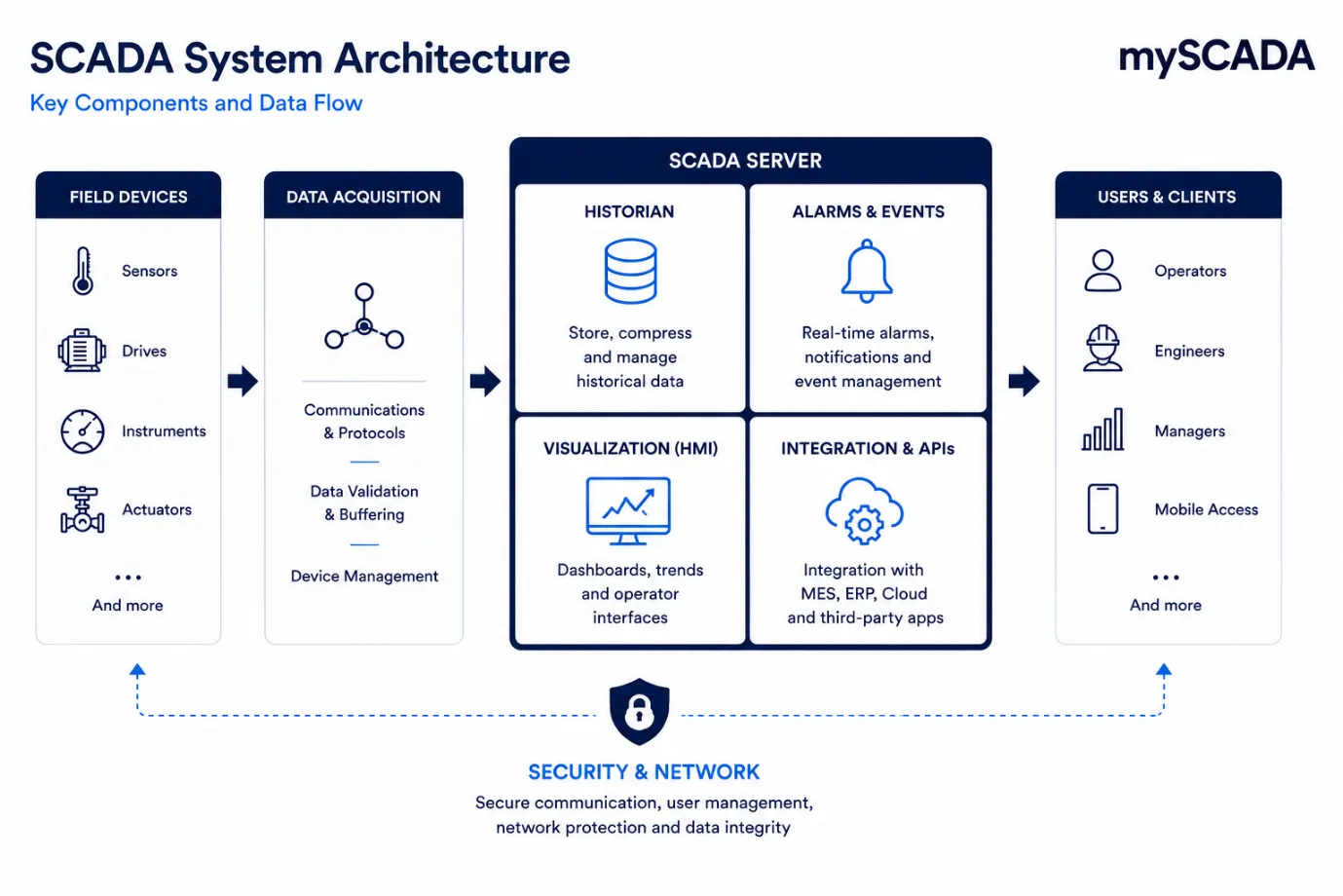
The SCADA server is the core intelligence of the system. It collects, processes, evaluates, and distributes operational data. While field devices generate raw data, the SCADA server transforms it into meaningful information and actionable events. Modern SCADA architecture consists of five main components.
1. Data Acquisition
The Data Acquisition module is the real-time interface between the control network (PLCs, RTUs, field devices) and the core SCADA services. It:
- Manages communication drivers and protocol stacks (Modbus, OPC UA, EtherNet/IP, MQTT, and others)
- Handles polling cycles or subscription-based data exchange
- Validates incoming data and assesses quality
- Timestamps values and updates the internal real-time tag database
- Provides buffering for loss-tolerant operation and redundancy support
This module isolates network variability from higher SCADA layers, ensuring deterministic data delivery to alarms, the historian, and HMI services.
2. Alarms & Events
The Alarms & Events (A&E) module operates as a real-time processing layer between data acquisition and the historian. It:
- Continuously evaluates incoming tag data against configured alarm rules (limits, state changes, logic conditions)
- Assigns priorities and timestamps events using synchronized system time
- Manages the full alarm lifecycle — activation, acknowledgment, return-to-normal
- Triggers notifications (visual, audible, SMS, email)
- Logs all operator interactions for accountability and audit compliance
By separating detection, notification, and historical storage, the A&E module ensures real-time response while maintaining reliable long-term event recording.
3. Historian
The historian is a specialized time-series database designed to store and manage process data over time. It:
- Stores time-stamped process data continuously
- Compresses and archives large volumes of data efficiently
- Computes aggregates (min, max, average, sum)
- Enables trend analysis and performance evaluation
- Supports reporting, KPIs, and long-term analytics
By maintaining accurate historical records, the historian enables root cause analysis, predictive maintenance, and data-driven decision-making.
4. Visualization Layer (HMI)
The Visualization Layer is the user-facing part of the SCADA system. It provides operators, engineers, and managers with clear, actionable insight into industrial processes. Operators access SCADA through:
- Dashboards displaying real-time KPIs and process status
- Alarm lists showing active and historical events
- Trend charts for analyzing time-based data
- Production overviews summarizing operational performance
- Mimic diagrams and process screens for detailed equipment control
Modern SCADA systems use web-based interfaces, enabling secure access from desktops, tablets, and mobile devices without installing specialized software.
5. Integration Layer
The Integration Layer connects SCADA with external IT systems, cloud platforms, and enterprise applications.
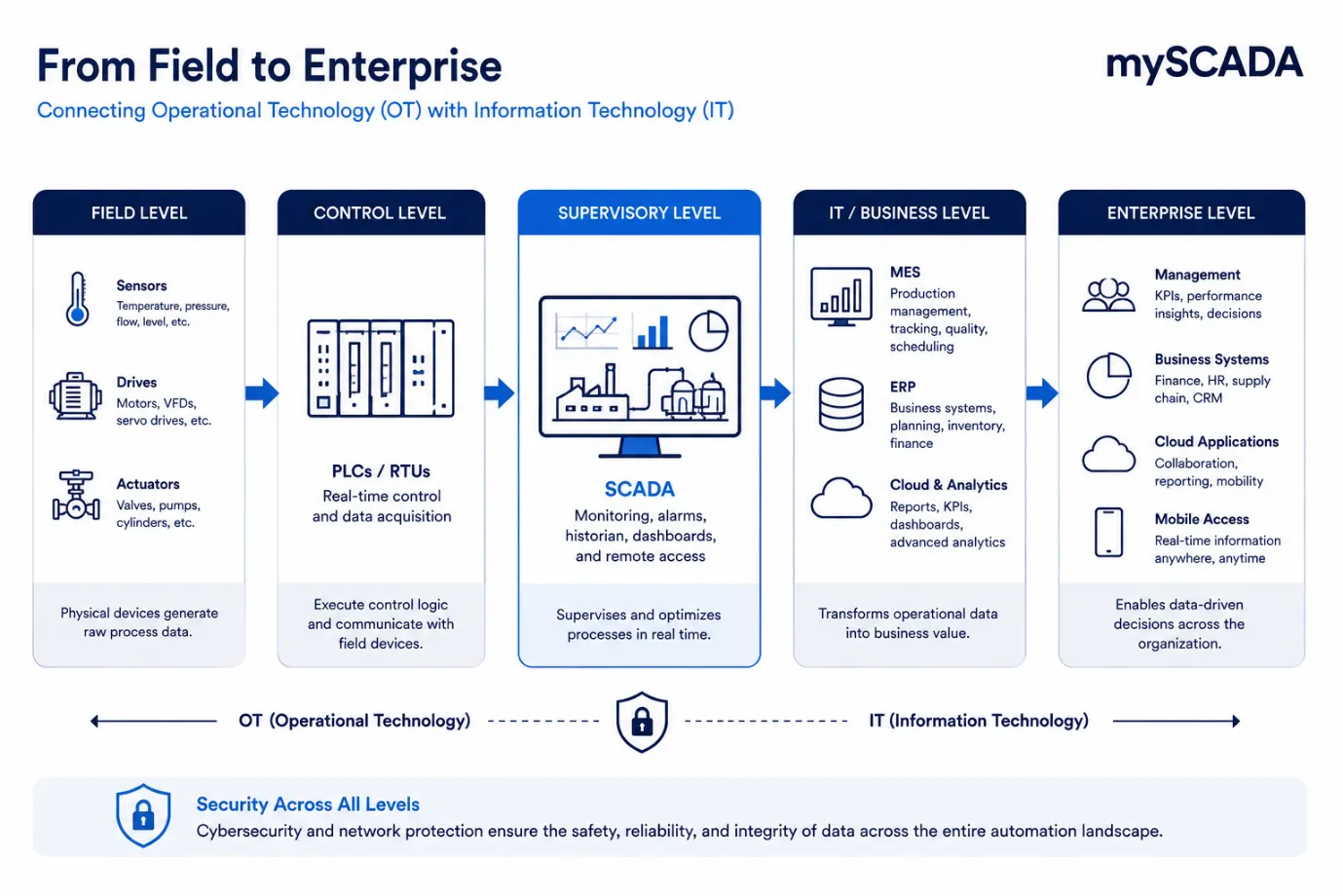
Advanced SCADA systems offer:
- REST APIs for real-time data exchange and application integration
- SQL access for reporting and business intelligence tools
- Cloud integration for centralized monitoring and advanced analytics
- Edge deployment for local processing and reduced latency
By enabling seamless connectivity between operational technology (OT) and information technology (IT), the Integration Layer transforms SCADA into a strategic bridge between industrial control and digital transformation.
Signs You Need a SCADA System
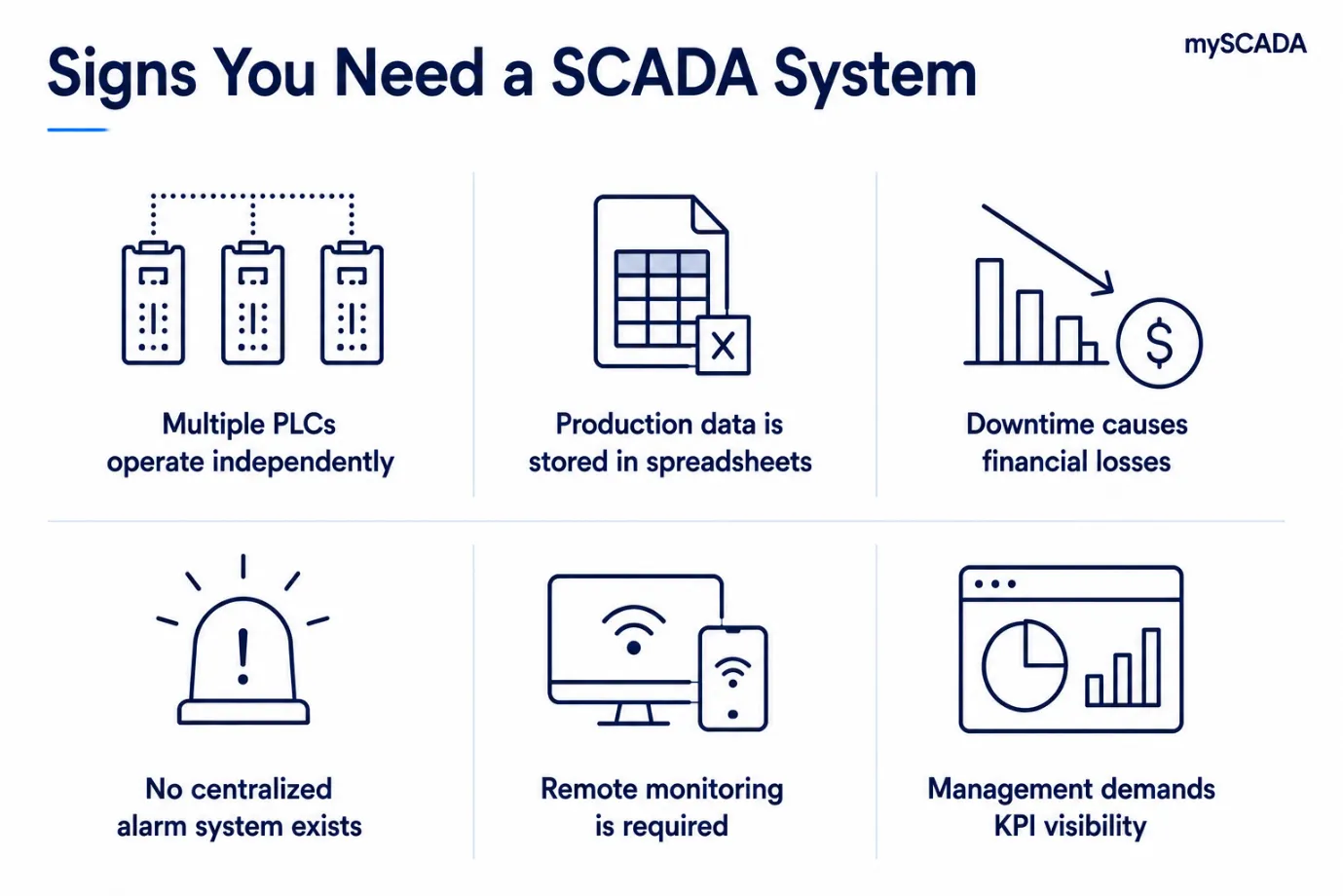
A SCADA system becomes essential when multiple PLCs operate independently without a unified view, production data is stored in spreadsheets, downtime causes financial losses, there is no centralized alarm system, remote monitoring is required, or management demands KPI visibility across operations.
Conclusion
SCADA (Supervisory Control and Data Acquisition) is an industrial control system used to monitor, control, and analyze processes in real time. It connects field devices — sensors, actuators, PLCs — to centralized software that collects data, visualizes operations, manages alarms, and stores historical information.
By transforming raw machine data into meaningful insights, SCADA enables operators and managers to improve efficiency, reduce downtime, enhance safety, and make informed decisions. Modern SCADA systems support remote access, advanced analytics, and enterprise integration — making them a key component of digital transformation in industry.
FAQ: SCADA Systems
What does SCADA stand for? SCADA stands for Supervisory Control and Data Acquisition — a system used to monitor, collect, and analyze real-time data from industrial processes.
What is the difference between PLC and SCADA? A PLC controls machines in real time using programmed logic. A SCADA system supervises multiple PLCs, collects their data, and provides visualization, alarms, and reporting.
What is the difference between SCADA and HMI? An HMI (Human–Machine Interface) is the screen operators use to interact with a single machine or process. SCADA is the entire system that collects data from many devices, supervises processes, stores history, manages alarms, and often spans multiple sites.
| Feature | PLC | HMI | SCADA |
|---|---|---|---|
| Real-Time Control | ✔ | ✖ | ✖ |
| Local Visualization | ✖ | ✔ | ✔ |
| Multi-Machine Overview | ✖ | ✖ | ✔ |
| Historical Data Storage | ✖ | Limited | ✔ |
| Central Alarm System | ✖ | Limited | ✔ |
| Remote Monitoring | ✖ | Rare | ✔ |
Is SCADA still relevant today? Yes. Modern SCADA systems support web-based access, cloud integration, edge computing, and advanced cybersecurity — making them essential in Industry 4.0 environments.
Can SCADA systems run in the cloud? Modern SCADA systems can run on-premise, in the cloud, or in hybrid architectures depending on security and operational requirements.
What industries use SCADA systems? Manufacturing, energy production, water treatment, oil & gas, logistics, infrastructure, and many more.